Jackpot Raider payments: methods, currencies and cashier
 Available in GB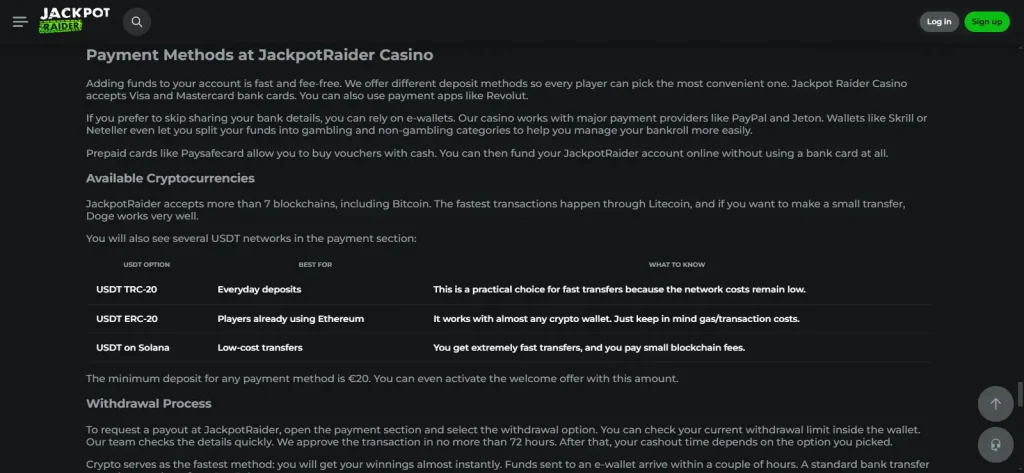
Table of Contents
- What the official site currently lists
- Cards, wallets and prepaid methods
- Crypto support depends on the network
- Euro is the internal operating currency
- Deposit choice shapes the later withdrawal route
- Fees and limits need a live cashier check
- How to compare methods without overclaiming
- Why the cashier view is more important than a public payment logo
- Payment selection should start with the full transaction cycle
- A practical pre-deposit payment checklist
- What UK readers should check inside the Jackpot Raider cashier
Section element
Payment guide
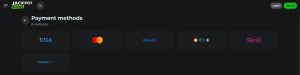
Jackpot Raider advertises cards, Revolut, PayPal, Jeton, Skrill, Neteller, Paysafecard and cryptocurrency options. Its terms state that the website operates internally in euros, so UK readers should not assume GBP is the underlying settlement currency. The public list shows global categories; the live cashier determines what is available for an individual account.
| Area | Detail | Context |
|---|---|---|
| Advertised | Cards + wallets | global list |
| Currency | EUR | internal currency |
| Withdrawals | Same method | published rule |
| UK status | Check cashier | account-specific |
What the official site currently lists
Jackpot Raider currently advertises Visa and Mastercard, Revolut, PayPal, Jeton, Skrill, Neteller, Paysafecard and cryptocurrency options. The public payment section also names Bitcoin and several USDT networks. This is a global operator list, not proof that every method appears for every residence or account.
For a UK reader, the live cashier matters more than a logo list. Payment availability can depend on residence, account status, currency, verification and the payment provider. A method should therefore be treated as advertised globally until the account itself shows that it is enabled. The KYC verification can affect the timing of a payout.
Jackpot Raider deposits and Jackpot Raider withdrawals follow different procedures; a method offered for funding is not necessarily suitable for receiving money.
Cards, wallets and prepaid methods
Cards are the most familiar category because the site names Visa and Mastercard directly. Revolut is positioned as an app-based payment option, while PayPal, Jeton, Skrill and Neteller are e-wallets. Paysafecard works differently because it is a prepaid voucher product rather than a normal bank card.
These categories are not interchangeable. A method that is convenient for depositing may have different withdrawal support or additional verification. Jackpot Raider’s account terms state that withdrawals must use the same method as the deposit, so the first funding choice can matter later.
A practical comparison asks whether a method can both deposit and receive payouts for the account, what currency is displayed and whether the cashier shows any method-specific threshold. Those answers belong in the live account view.
Crypto support depends on the network
The official site advertises cryptocurrency support and specifically mentions Bitcoin plus USDT on TRC-20, ERC-20 and Solana. The network label is a material part of the transaction, not a cosmetic detail.
A user sending USDT needs to match the network shown by Jackpot Raider with the network selected in the sending wallet. The published terms warn about deposits sent to incompatible cryptocurrency network addresses, which can create difficult recovery situations.
Blockchain fees and confirmation times are external to the casino. Even where the site describes one network as fast or low-cost, the exact cost changes with network conditions and the sending wallet. The live transfer instructions should therefore be checked before every crypto deposit.
Euro is the internal operating currency
Jackpot Raider’s published payout terms state that the website’s internal operating currency is euro. They also explain that transactions in other currencies can involve conversion by a bank or the casino’s payment-processing system.
GBP can appear in product currency equivalents without becoming the site’s internal operating currency. A UK card or wallet can therefore show a sterling amount while the underlying processing still involves euro conversion.
The useful question is not simply whether GBP appears somewhere on the site. A reader should check the account currency, the denomination shown in the cashier and the final amount on the confirmation screen before approving a transaction.
Deposit choice shapes the later withdrawal route
The same-method rule means the deposit method can shape the cashout path. A quick deposit method is not automatically the most practical choice if it cannot receive the later withdrawal in that account.
Before funding, check whether the selected method also appears under withdrawals. If it does not, the account may need a different approved route, but that fallback should not be guessed in a static guide.
This connection is why the deposit page and withdrawal page are separate. One explains how money enters the account; the other explains rules and timing after a cashout request.
Fees and limits need a live cashier check
The public homepage describes deposits as fee-free, but that does not mean every transaction is free of all external cost. Currency conversion, intermediary banks and blockchain network fees can sit outside the casino’s own deposit charge.
Limits are also account-sensitive. The payout terms say a withdrawal can be limited per day, week or month and direct users to the cashier for the current value. A static article should not invent one universal maximum.
The last transaction screen is therefore the most useful source for the exact amount, fee, currency and limit attached to a real transfer. Public copy provides context; the cashier provides the account-specific value.
How to compare methods without overclaiming
A payment-method table is most useful when it distinguishes category from account availability. Cards, e-wallets, prepaid products and crypto each solve different practical problems, but none should receive a UK-supported label without a fresh account check.
Currency deserves the same treatment. The site can show sterling equivalents while operating internally in euro, so conversion is a separate decision factor. A small difference in displayed and settled amounts can come from the payment provider rather than from a hidden casino fee.
The Jackpot Raider review covers the wider product, while the live cashier determines which advertised payment routes are enabled for a specific account.
Why the cashier view is more important than a public payment logo
Public casino pages are designed to explain the range of available payment categories, but they rarely reproduce every residence filter, provider rule and account-state restriction that applies at transaction time. The cashier has the opposite purpose: it is built around the account that is currently logged in. That is why a method that appears on a marketing page can still be absent from an individual cashier, and why a payment option can appear only after certain account details are completed.
For comparison work, this means the public page is useful for discovery while the cashier is useful for confirmation. A UK reader can use the public list to understand that Jackpot Raider works with cards, wallets, prepaid products and crypto, then use the account screen to see what is actually enabled. The distinction also helps with stale third-party reviews, because a current cashier view can supersede an older payment table without requiring a guess about why the change happened.
The same logic applies to denominations. A site can publish values in several currencies for convenience while still operating internally in euro. The transaction confirmation is where a reader can see the amount that will actually be charged, whether a conversion is taking place and whether the provider shows a separate cost. That is more decision-useful than a generic statement that a casino ‘supports GBP’.
Payment selection should start with the full transaction cycle
A deposit is only the first half of a payment decision. The better comparison starts with the complete cycle: funding the account, meeting any verification or playthrough requirements, requesting a withdrawal and receiving the money back through an eligible route. The published same-method rule makes that full-cycle view especially relevant at Jackpot Raider.
For example, an e-wallet can be attractive because it separates gambling transactions from a main bank card, while a prepaid product can limit the amount initially exposed. Crypto can provide another route but adds network selection and wallet handling. Cards remain familiar, yet their availability and regulatory context can differ by market. None of these categories is universally ‘best’; the practical choice depends on which option is visible in the cashier and can support the user’s intended deposit-and-withdrawal path.
That is also why fee claims need context. A casino can charge no deposit fee while a bank, wallet, intermediary or blockchain still introduces a cost. Before confirming a payment, check the final debited amount and the receiving amount rather than relying on a single label such as ‘free’.
The first choice can affect several later stages. An eligible player may fund an account through an advertised method, but the payout route is still subject to the stated same-method rule and any identity or payment-ownership checks. A wallet or card selected for convenience at deposit time should therefore also be considered as a possible receiving route. Changing devices or using the mobile site does not remove the account-level payment conditions.
Currency is another part of the same transaction. The casino states that euro is its internal operating currency, while a bank or payment processor can convert funds from another denomination. A pounds-to-euros deposit and a later withdrawal need not use identical rates or charges. Those figures depend on the selected provider and the time of the transaction, so a universal GBP amount would not describe every account.
A practical pre-deposit payment checklist
Before moving money, compare the cashier against the public payment page one last time. Confirm the method name, account currency, deposit amount, any conversion shown and whether the same method is visible for withdrawals. If the account displays a different set of options from an older review, use the live account view rather than assuming the older list still applies.
For card or wallet payments, also check the final confirmation screen supplied by the payment provider. For crypto, verify the asset and network together and copy the destination carefully. These checks are simple, but they address the most common point of failure: treating a general payment category as though it guarantees the exact route, denomination and conditions for a particular account.
What UK readers should check inside the Jackpot Raider cashier
For a UK reader, the final checklist is short but important. Confirm which methods appear after login, which account currency is selected, whether the deposit method is also available for withdrawals, what minimum and maximum are shown and whether the confirmation screen displays a conversion or fee.
This avoids two common errors: assuming every global payment logo works for a UK account and assuming that GBP references mean the casino settles internally in pounds. Neither conclusion follows from the public site.
Jackpot Raider’s public payment information is useful for identifying the available categories. The live cashier is the place to verify the method, denomination and transaction conditions for the individual account.