Jackpot Raider games and casino library
 Available in GB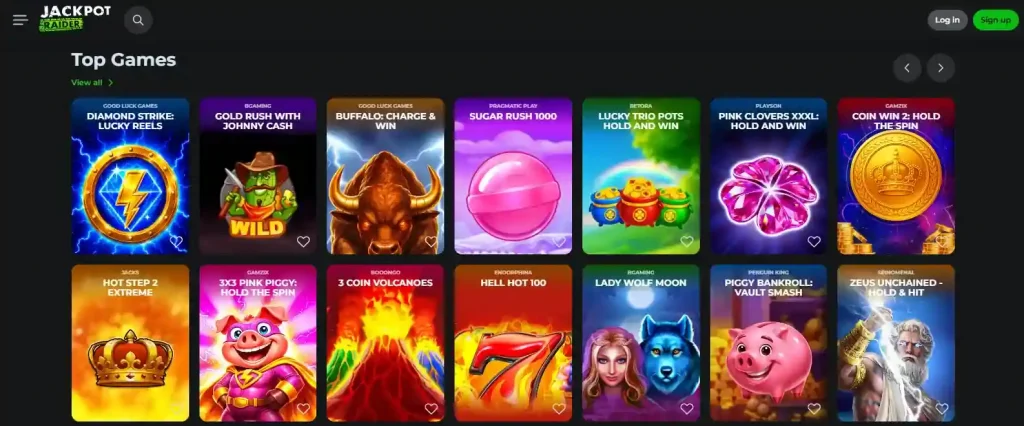
Table of Contents
- A large library needs a map, not a title dump
- Slots form the core of the catalogue
- Live casino is a separate experience
- Demo mode makes a huge catalogue easier to test
- Instant-win, crash and fishing games fill the gaps between major categories
- Provider breadth matters most when it changes the choice of games
- How to navigate the library efficiently
- What the library does well – and what the size does not prove
- Category labels help more than raw game counts
- How the Jackpot Raider game library is actually organised
- Explore the library
Section element
Casino library
Jackpot Raider advertises more than 6,000 games from over 90 providers. The catalogue spans more than 5,000 slots, a separate live-casino section, table games, instant-win formats, fishing games, jackpots and Jackpot Raider Originals. Most non-live titles can be opened in demo mode without logging in, which makes the size of the library easier to explore before real-money play. The practical challenge is not finding enough games but navigating a catalogue this large.
| Area | Detail | Context |
|---|---|---|
| Total library | 6,000+ | advertised games |
| Providers | 90+ | current operator wording |
| Slots | 5,000+ | largest category |
| Demo play | Most games | live tables excluded |
A large library needs a map, not a title dump
Six thousand games sounds impressive, but raw catalogue size does not tell a reader whether the lobby is usable. Jackpot Raider’s current presentation is better understood as several distinct browsing routes: slots, live casino, instant-win formats and smaller specialist categories. The operator also promotes provider breadth, saying it works with more than 90 game studios.
The useful question is therefore how quickly a player can move from a broad category to a game type that matches a specific preference. Someone looking for a conventional slot has different needs from a player searching for a live roulette table or a quick crash-style game. Treating all 6,000 titles as one undifferentiated list makes the number less meaningful.
The Jackpot Raider review places the game library alongside payments and account access; the lobby itself separates slots, live tables and other formats.
Slots form the core of the catalogue
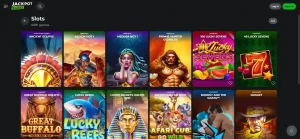
Jackpot Raider says it hosts more than 5,000 slot releases. That makes slots the dominant part of the library and explains why the operator can support multiple mechanics rather than a single “popular slots” shelf. Its own casino description references classic three-reel formats alongside feature-heavy modern releases, while the live site highlights mechanics such as Bonus Buy, Hold & Win, Megaways-style play and progressive or jackpot-oriented titles.
A catalogue of this size benefits from filtering by mechanic or provider instead of browsing page after page. Players who already know whether they prefer bonus-buy games, high-volatility formats, simple reel structures or progressive jackpots can narrow the search much faster than by relying on the default lobby ranking.
The Jackpot Raider slots section includes different reel mechanics, bonus features and ways to filter titles.
Live casino is a separate experience
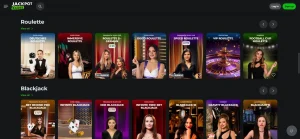
Live casino is not just another label inside the slot library. Jackpot Raider maintains a separate live section with real-dealer tables and game-show formats. Current lobby material shows Evolution titles and the operator describes streams from more than ten live providers. The selection includes roulette, blackjack, baccarat and game-show formats alongside provider-specific variants.
This matters because the decision criteria are different from slots. Live tables depend on dealer presentation, table limits, game speed, side bets and studio format. Demo play is also treated differently: Jackpot Raider says almost any casino game can be tried in demo mode except live tables. A reader comparing the library should therefore evaluate live content as a parallel category, not as an extension of slots.
For table formats, studios and the practical differences between live-dealer options, continue to the live casino.
Demo mode makes a huge catalogue easier to test
One of the more practical features in Jackpot Raider’s current casino description is demo access. The operator says almost any game can be launched in demo mode without logging into an account, with live tables excluded. Demo games use virtual credits while retaining the game’s basic mechanics and bonus features.
That makes demo mode particularly useful in a library with thousands of titles. It lets a player check whether a slot’s pace, interface, bonus structure or volatility feels suitable before committing real money. It also reduces the need to rely on a game thumbnail or promotional name as a proxy for how the title actually plays.
Demo mode should not be confused with evidence of likely returns. It is a product-testing tool, not a prediction of future outcomes. A high displayed RTP is a mathematical long-run figure for a specific game configuration, not a guarantee of an individual session result.
Instant-win, crash and fishing games fill the gaps between major categories
Jackpot Raider’s catalogue also contains fast-format games that do not fit neatly into the traditional slot or live-table buckets. The operator highlights crash-style games, Plinko variants, fishing titles and its own Originals. These formats can have very different interaction models, from choosing when to cash out in a rising-multiplier game to selecting risk levels in Plinko or using arcade-like fishing mechanics.
These categories are worth mentioning because they add real variety, but they do not need separate thin pages. The most useful distinction is functional: instant-win and crash games tend to deliver short rounds and direct interaction, while fishing games add an arcade layer, and Originals give the operator a branded category of its own.
Bonus users should also remember that contribution can vary sharply by category. Jackpot Raider’s current bonus rules list standard slots at 100% contribution, Instant Win at 5%, and some live or table categories at zero. The bonus wagering rules determine the relative contribution of those categories.
Provider breadth matters most when it changes the choice of games
The operator’s 90+ provider claim is useful because it signals that the catalogue is not dependent on one studio. Current Jackpot Raider material names or displays suppliers such as Evolution, Pragmatic Play, BGaming, BetSoft, Endorphina and other studios across casino categories. In practice, different suppliers bring different strengths: some are known for live studios, some for feature-heavy slots, some for arcade-style instant games and others for more traditional casino formats.
There is little value in reproducing a list of ninety provider names. A better use of provider information is to ask whether the lobby contains enough distinct game styles to make filters meaningful. On that measure, Jackpot Raider’s mix of large live suppliers, slot studios and instant-game developers supports a broader catalogue than a single-provider casino skin.
How to navigate the library efficiently
Start with format, not title. Choose slots, live casino or fast games first. Then narrow by provider or mechanic if the lobby offers the relevant filter. If a non-live title looks interesting, use demo mode to test the pacing and controls. Only after that is it useful to compare details such as volatility, feature frequency, paytable structure or game-specific RTP information.
This sequence saves time because lobby rankings can change and “top games” sections often mix popularity, recency and promotional placement. A game that sits high in the lobby is not automatically better suited to a particular player. The browsing tools are more valuable when they help reduce thousands of options to a manageable shortlist.
For anyone using a promotion, add one more check before real-money play: confirm whether the selected game contributes fully to wagering and whether it appears on the restricted-games list. That rule belongs to the bonus system, not the quality of the game itself.
A useful starting point is the category rather than the front-page promotional row. Someone seeking reel mechanics can begin with slots and narrow the selection by provider or feature; someone interested in hosted tables can use the live-casino section. Demo play, where offered, lets a visitor examine controls without treating a short sample as evidence of future results. Game information should be read title by title for return-to-player figures, volatility and any bonus restrictions, because a broad category label cannot supply those details for every title.
What the library does well – and what the size does not prove
The strongest verified feature is breadth. More than 6,000 titles, over 5,000 slots and 90+ providers give Jackpot Raider enough content to support multiple styles of casino play. The separate live section and the presence of instant-win, fishing and Original formats make the catalogue more varied than a slot-only lobby. Demo access across most non-live games also gives the size a practical use.
What these numbers do not prove is universal geographic access, identical provider availability in every country or better odds for an individual player. Game catalogues can vary by jurisdiction and provider restrictions, while RTP and volatility remain game-specific mathematical properties. The right conclusion is that Jackpot Raider has a broad global library, not that every one of those titles is necessarily available to every reader.
Category labels help more than raw game counts
Large casino lobbies can create a discovery problem: the more titles are available, the less useful a single chronological grid becomes. Category labels solve part of that problem by turning a six-thousand-game catalogue into smaller decision sets. A player can begin with live dealer, slots or instant formats, then refine the choice by mechanic, studio or theme rather than treating every tile as equally relevant.
This also makes updates easier to interpret. New releases can enter a familiar category without changing how the rest of the library is navigated. A changing front-page row therefore does not necessarily mean the underlying catalogue structure has changed. For editorial comparison, stable features such as category breadth, demo access and provider diversity are more useful than recording a temporary list of trending titles.
Provider filters can be especially valuable when a player already knows a studio’s interface or game style. The purpose is not brand loyalty to a supplier but faster discovery. If a studio is associated with particular live formats, slot mechanics or visual styles, narrowing the lobby by provider can reduce search time while still leaving multiple games to compare.
How the Jackpot Raider game library is actually organised
Search tools also become more important as a catalogue grows. A direct title search is useful when a player already knows the game, while category and provider filters are better for discovery. Together, those tools turn catalogue size from a marketing statistic into something that can actually be navigated without excessive scrolling.
Jackpot Raider’s 6,000+ game count is easiest to understand as a set of layers. Slots are the largest layer, live casino forms a separate real-dealer branch, and instant-win, crash, fishing and Original games provide alternative formats around them. The 90+ provider network supplies enough variety that browsing by category or studio is more useful than scrolling through an undifferentiated list.
For a reader trying to evaluate the casino rather than simply count tiles, the practical advantages are the combination of scale, category separation and demo access for most non-live titles. The next useful step is to choose the relevant branch: explore slots in detail, compare live dealer games, or review the bonus wagering rules that can change how different game categories count during a promotion.